
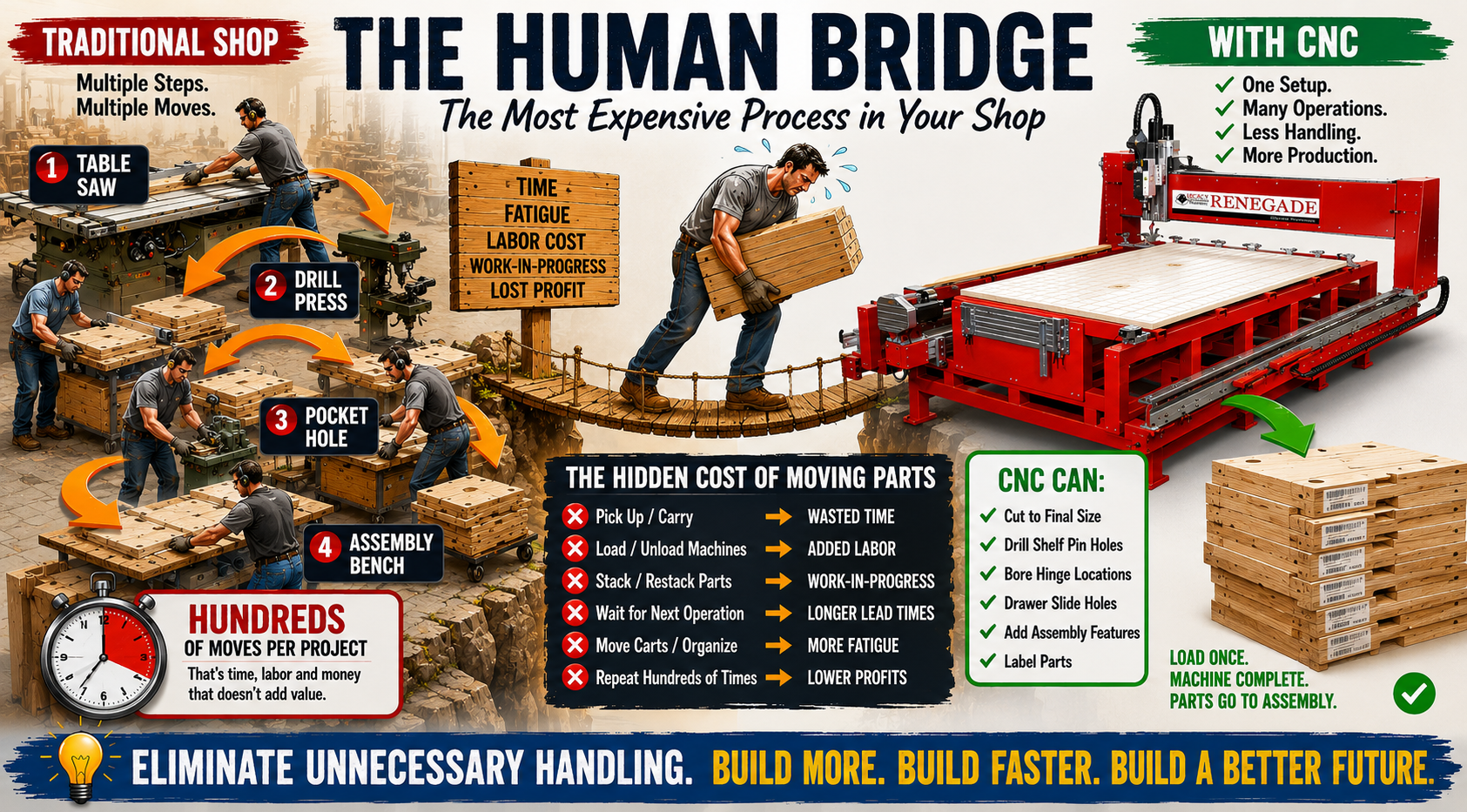
Moving parts between machines may cost you more than labor, tooling, or material waste.
Most woodworking shop owners believe labor is their largest expense.
At first glance, that seems obvious. Payroll is easy to see. Every week the checks are written, taxes are paid, and labor costs appear clearly on financial reports.
But what if the most expensive labor in your shop isn’t building products?
What if it’s moving them?
In many woodworking businesses there is a hidden process consuming time, energy, floor space, and profitability every single day. It rarely appears on an invoice and almost never shows up as a line item on a profit and loss statement.
We call it the Human Bridge.
What Is the Human Bridge?
The Human Bridge is the person responsible for moving material and parts between operations.
Traditional woodworking shops are built around specialized machinery. Each machine performs one task exceptionally well.
A table saw cuts parts to size.
A drill press drills holes.
A pocket hole machine creates joinery.
A mortiser cuts mortises.
A shaper profiles edges.
A planer flattens stock.
A jointer straightens edges.
Every machine is valuable.
The problem is that none of them finish the project.
Between every machine stands a person responsible for bridging the gap.
That person picks up the workpiece, carries it to the next machine, waits for the next operation, organizes parts, stacks components, pushes carts, and repeats the process throughout the day.
The Human Bridge becomes the transportation system that keeps the entire shop functioning.
Unfortunately, transportation does not create value.
Customers Don’t Pay for Movement
Think about the last project you delivered.
Whether it was a kitchen, an entertainment center, a dining table, or a set of custom doors, the customer paid for the finished product.
They did not pay because a cabinet side was moved from a table saw to a drill press.
They did not pay because a door stile was carried from a shaper to an assembly bench.
They did not pay because material sat on a cart waiting for the next operation.
Yet these activities consume a significant percentage of the labor hours in many woodworking businesses.
The challenge is not that moving parts is difficult.
The challenge is that it doesn’t increase the value of the finished product.
It simply consumes resources.
The Traditional Cabinet Shop Workflow
Consider a typical cabinet shop building a kitchen.
The production process may look something like this:
- Load sheet goods onto the table saw.
- Cut cabinet parts.
- Stack parts on a cart.
- Move parts to a drilling station.
- Drill shelf pin holes.
- Move parts again.
- Drill hinge locations.
- Move parts again.
- Add pocket holes.
- Move parts to assembly.
Every step requires handling.
Every handling step consumes labor.
Every labor hour increases production cost.
Now multiply that process by an entire kitchen.
Thirty sheets of melamine or plywood are common for a medium-sized project.
Each sheet may yield six to ten cabinet components.
That means the shop is processing approximately 180 to 300 individual parts before assembly begins.
Most of those parts require one or more secondary operations.
Shelf pin holes.
Drawer slide holes.
Hinge boring.
Pocket holes.
Assembly preparation.
The result is hundreds of pieces moving throughout the shop multiple times.
The Human Bridge stays busy all day.
Unfortunately, busy and productive are not always the same thing.
The Hidden Cost of Work in Progress
Material movement creates another hidden expense.
Work-in-progress inventory.
When parts move from machine to machine, they often stop and wait.
They wait for another operator.
They wait for another machine.
They wait for setup changes.
They wait for priorities to shift.
They wait for someone to become available.
As a result, carts accumulate throughout the shop.
Stacks of partially completed parts occupy valuable floor space.
Material becomes difficult to track.
Projects become harder to manage.
Lead times increase.
Production slows.
Every waiting part represents money invested but not yet recovered.
In many shops, the Human Bridge isn’t simply moving parts.
The Human Bridge is also managing the delays created by moving parts.
The Physical Cost Nobody Calculates
Many woodworking business owners feel this cost every evening.
Most sheet goods weigh between 70 and 90 pounds.
A typical kitchen requiring thirty sheets represents between 2,100 and 2,700 pounds of raw material before cutting begins.
Once processed, those sheets become hundreds of individual components.
Each component may be handled multiple times.
Lifted.
Carried.
Stacked.
Restacked.
Loaded.
Unloaded.
Transported.
Month after month.
Year after year.
For many shop owners, the Human Bridge is not an employee.
It is the owner.
The same person responsible for:
- Sales
- Estimating
- Customer service
- Scheduling
- Purchasing
- Quality control
- Business growth
The owner often spends valuable hours moving parts instead of growing the company.
At some point the physical cost becomes a capacity problem.
The business can only grow as fast as the owner can carry material.
The Capacity Ceiling
Many woodworking shops believe they need additional employees to increase production.
Often, they need fewer production steps instead.
Every time a project changes workstations, productivity slows.
Every time material is handled, labor costs increase.
Every time a part waits in line, lead times expand.
Eventually the shop reaches a production ceiling.
Not because machinery lacks capacity.
Not because demand is lacking.
But because too much labor is devoted to transportation rather than production.
The Human Bridge becomes the bottleneck.
How CNC Changes the Workflow
A CNC woodworking system approaches production differently.
Instead of dividing operations among multiple machines, many operations are combined into a single setup.
A properly configured CNC workflow can:
- Cut parts to final dimensions
- Drill shelf pin holes
- Bore hinge locations
- Machine drawer slide holes
- Create joinery features
- Add assembly holes
- Label parts for assembly
All without moving the part from one machine to another.
The material is loaded once.
The machining operations are completed.
The finished components move directly to assembly.
The reduction in handling is often dramatic.
The reduction in labor can be significant.
The reduction in physical strain can be life changing.
CNC Doesn’t Replace Craftsmanship
One of the biggest misconceptions about CNC technology is that it replaces woodworking skills.
It doesn’t.
Craftsmanship still matters.
Design still matters.
Material selection still matters.
Assembly still matters.
Finishing still matters.
Customer relationships still matter.
What CNC technology often eliminates is the non-value-added labor that prevents skilled woodworkers from focusing on their craft.
The goal is not replacing people.
The goal is to eliminate unnecessary work.
Walk Through Your Shop
Tomorrow morning, choose a single part.
Follow it from raw material to final assembly.
Count every time it is:
- Picked up
- Set down
- Moved
- Stacked
- Restacked
- Loaded
- Unloaded
- Waiting
Then ask yourself a simple question:
How much of my day is spent building products?
And how much of my day is spent moving products?
The answer may reveal the true bottleneck in your business.
For many woodworking shops, the most expensive process isn’t cutting wood.
It isn’t drilling holes.
It isn’t assembly.
It’s transportation.
The Human Bridge may be the hardest-working employee in the shop.
The question is whether that work is creating value.
Or simply consuming it.
Build more, build faster, build a better future