
By John Hennen
Over the years, I’ve had the opportunity to speak with hundreds of woodworkers who were considering the move to CNC technology. Cabinet makers. Furniture builders. Architectural millwork shops. Hobbyists turning their passion into a business. Established manufacturers looking for greater efficiency.
While every shop is different, I have noticed something interesting:
Very few woodworkers wake up one morning and decide they simply want a CNC machine.
Instead, they usually arrive at that decision because they are trying to solve a problem.
The CNC machine is the solution.
The problem is what drives the decision.
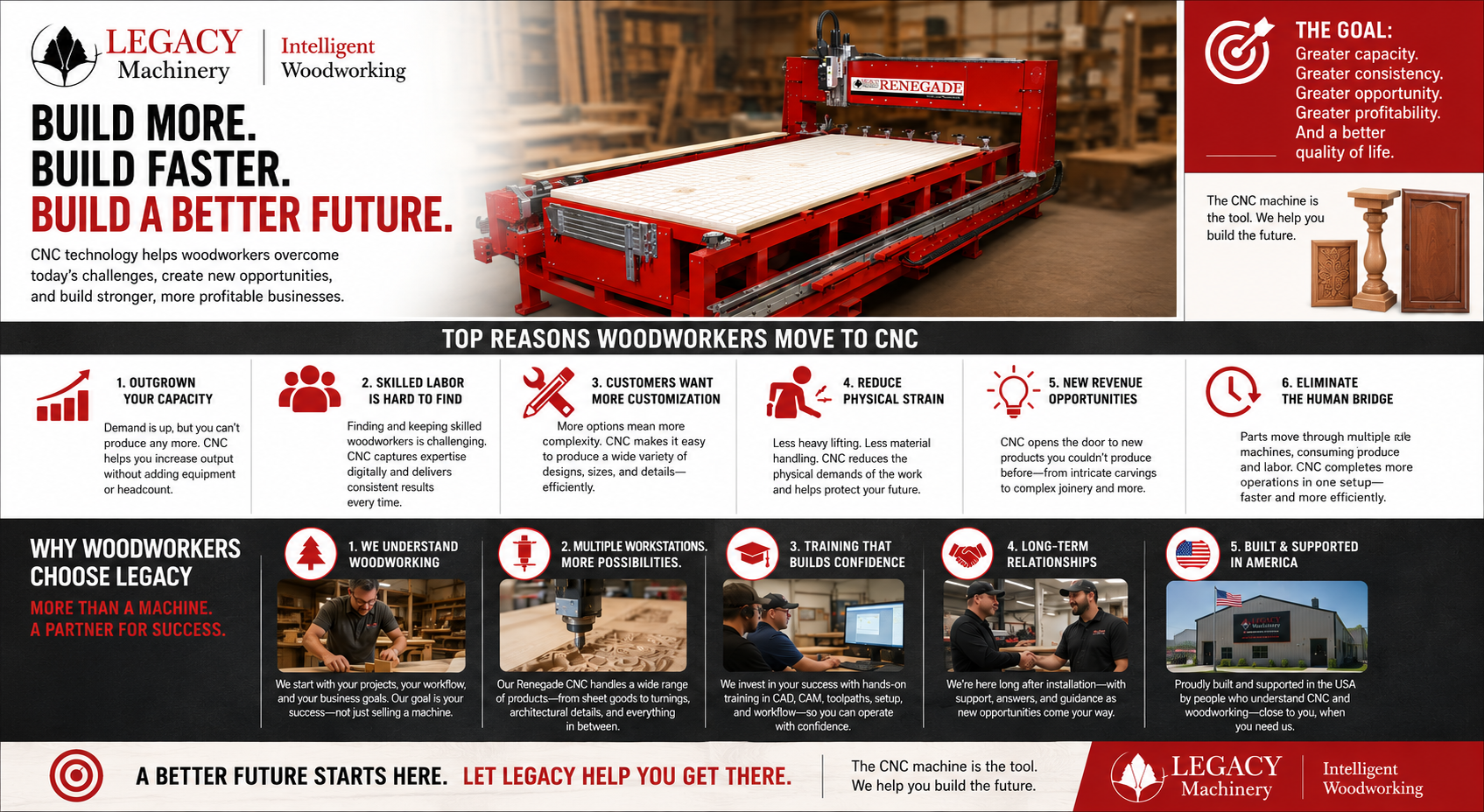
The Reasons Woodworkers Start Looking
Most customers begin their CNC journey for one or more of these reasons:
They Have Run Out of Capacity
Many shops reach a point where they simply can’t produce any more work.
The owner is working longer hours.
Employees are already stretched thin.
Lead times are growing.
Projects are waiting in line for equipment or labor.
The business is successful, but growth has stalled.
A CNC system allows one machine to perform many operations automatically, increasing production capacity without adding multiple employees or additional equipment.
Skilled Labor Is Becoming Harder to Find
This may be the most common challenge I hear today.
Experienced woodworkers are difficult to find.
Training new employees takes time.
Turnover creates disruption.
Many shops have become dependent on one or two highly skilled individuals who carry a large portion of the production workload.
CNC technology helps preserve and multiply skilled labor by capturing processes digitally and producing consistent results day after day.
Customers Want More Customization
Today’s customers expect options.
Different sizes.
Different styles.
Different materials.
Different details.
Traditional manufacturing methods often become less efficient as customization increases.
A CNC system allows shops to make design changes digitally instead of building new templates, jigs, fixtures, and tooling for every variation.
The Physical Work Is Taking a Toll
Many shop owners have spent decades moving material.
Lifting sheet goods.
Handling large assemblies.
Transporting parts between machines.
Standing at equipment all day.
The physical demands of woodworking are real.
Many customers tell me they want to continue woodworking for years to come while reducing the wear and tear on their bodies.
CNC technology can dramatically reduce material handling and repetitive operations.
They Want New Revenue Opportunities
Many woodworkers discover that CNC technology allows them to offer products they previously could not produce efficiently.
Decorative carvings.
Custom doors.
Complex furniture joinery.
Turned components.
Signs.
Inlays.
Architectural details.
Custom cabinetry.
A CNC doesn’t simply help shops produce existing products faster.
It often helps them produce entirely new products.
The Human Bridge Problem
One concept I frequently discuss with customers is what we call “The Human Bridge.”
In a traditional woodworking shop, every project moves through a series of specialized machines.
Table saw.
Jointer.
Planer.
Drill press.
Pocket hole machine.
Shaper.
Mortiser.
Router table.
Sander.
Assembly bench.
Each machine performs one operation exceptionally well.
But someone must move the workpiece between every operation.
That person becomes the bridge connecting the machines.
Every time a part is picked up, carried, stacked, sorted, or moved, labor is being consumed without adding value to the product.
Customers consistently tell us they are surprised by how much time is spent moving material rather than actually producing finished products.
One of the biggest benefits of CNC technology is reducing the need for that human bridge.
Many cabinet parts, furniture components, and joinery operations can be completed in a single setup.
Less handling.
Less waiting.
Less work-in-progress.
More productivity.
Why Customers Choose Legacy
Once woodworkers decide they want to explore CNC technology, they face another decision:
Which CNC company should they trust?
There are many CNC manufacturers in the marketplace.
Yet our customers repeatedly tell us they chose Legacy for several important reasons.
We Understand Woodworking
Many CNC companies understand machinery.
Legacy understands woodworking.
Our conversations begin with projects, products, workflows, and business goals.
We want to understand what you build before we discuss what machine you need.
The goal is not simply selling a CNC.
The goal is helping you improve your woodworking business.
Multiple Workstations Create More Opportunities
Many CNC systems are designed primarily for flat panel processing.
Legacy systems were designed to help woodworkers create a wider range of products.
Our customers value the ability to process:
- Sheet goods
- Furniture components
- Doors
- Compound-angle joinery
- Turnings
- Spindles
- Table legs
- Decorative carvings
- Wrapped carvings
- Architectural millwork
The ability to produce many different products on one system often becomes a significant advantage.
Training Matters
One of the biggest concerns prospective buyers have is simple:
“Can I learn this?”
The answer is yes.
But learning matters.
Technology alone does not create success.
Training creates success.
That is why Legacy invests heavily in training and support.
We help customers develop skills in:
- CAD drawing
- CAM programming
- Toolpath creation
- Machine setup
- Production workflow
- Project development
Our goal is not just to deliver a machine.
Our goal is to help create a confident CNC operator.
We Build Long-Term Relationships
One thing I hear repeatedly from Legacy customers is that they appreciate having someone available after the sale.
Questions arise.
New projects appear.
New opportunities develop.
Customers continue learning.
The relationship doesn’t end when the machine is installed.
In many ways, that’s where the relationship truly begins.
Made and Supported in America
For many customers, local support matters.
They want access to people who understand their equipment.
They want training.
They want service.
They want answers.
Legacy customers appreciate knowing their machines are built and supported by people who understand both CNC technology and woodworking.
The Real Reason Customers Move to CNC
After all the discussions, demonstrations, calculations, and comparisons, the reason most customers move to CNC comes down to one thing:
They want a better future for their business.
They want greater capacity.
Greater consistency.
Greater opportunity.
Greater profitability.
And often, a better quality of life.
The CNC machine is simply a tool.
What matters is what that tool allows them to become.
That is the journey we help our customers take every day.
And that is why so many woodworkers choose Legacy as their partner when it’s time to make the move.